
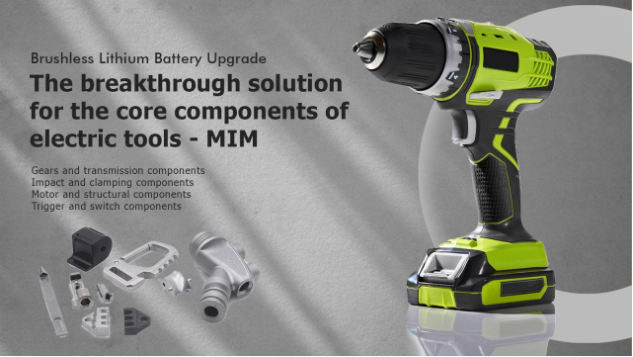
According to Grand View Research, the global market size of brushlesslithium-ion power tools is expected to reach USD 48.2 billion by 2026, withthe EU and North America contributing 62% of the demand. Driven by theEU’s New Battery Regulation (Regulation (EU) 2023/1542) and U.S. DOEenergy efficiency standards, core components face rigid requirements for”higher precision, lower carbon footprint, and stronger durability.” MetalInjection Molding (MIM) technology-boasting three core advantages:complex structure forming, high material utilization, and batch costoptimization-has become a highly compatible solution for corecomponents like gears, housings, and transmission parts, precisely meetingboth market trends and regulatory compliance needs.
I. Brushless Lithium-ion: Three Core Requirements for Components
The application of brushless lithium-ion technology in power tools hasevolved from “replacing corded tools” to a new stage of “system-levelperformance upgrading.” The core driver lies in end-users’ comprehensivedemands for “efficient operation, low usage costs, and complianceadaptation”-all ultimately pointing to process innovation for core metalcomponents.
1. Precise Adaptation
By 2026, mainstream brushless motors will have a power density exceeding1.2kW/kg (a 15% increase from 2025), requiring transmission components(gears, drive shafts) to achieve tooth profile accuracy of ISO 1328-2:1997Class 6 or higher. High-precision tooth profiles reduce meshing gaps andenergy loss, helping motors surpass 85% energy efficiency to meet thelatest U.S. DOE standards. Meanwhile, the high-frequency start-stop ofbrushless motors demands rotor bracket dynamic balance deviation <5g ·mm-requirements that MIM technology precisely fulfills.
2. Long Service Life & High Durability
End-users of industrial-grade power tools (e.g., construction andmanufacturing enterprises) have made “tool service life” a coreprocurement criterion, requiring professional-grade tools to achieve over5,000 hours of continuous service. Core components must reach HRC 45-50hardness and withstand 1.5J impact without deformation. Traditionalstamping/casting processes yield components with density below 90%,failing to meet these standards. In contrast, MIM technology-via near-netshaping and high-temperature sintering-boosts component density to95%-99% (close to forging levels), fundamentally extending service life.
3. Environmental Compliance
Starting in 2027, the EU’s New Battery Regulation mandates full-life-cyclecarbon footprint declarations for power tool batteries, with core componentcarbon emissions included in assessments. It also bans harmful substanceslike lead and mercury. Traditional machining has a material utilization rate ofonly 30%-50%, leading to high carbon emissions. MIM technology-withover 95% material utilization and compatibility with eco-friendly materials(e.g., stainless steel, lead-free alloys)-is the key to breaking through EUand U.S. compliance barriers.
II. Precise Alignment of MIM Solutions
MIM is not a simple “processing technology replacement” but a full-chainsynergy of “design-material-process-inspection” that accurately matchescore component needs amid 2026’s brushless lithium-ion trends. Itsadaptation logic is analyzed in three dimensions:
1. Structural Adaptation: Optimal Solution for Complexity + Lightweight
The 2026 trend toward “lightweight and integrated” brushless lithium-iontools has led to more complex core component designs: rotor bracketsneed integrated magnet installation slots, positioning holes, and heatdissipation channels; transmission housings require 1.5-2.5mm thin wallsand special-shaped structures. Traditional processes demand “multi-stepmachining + assembly,” with a 10-15 day production cycle and performancerisks from assembly errors.
MIM’s full process-“powder feed injection-debinding-sintering” -enablesone-step forming of complex structures, eliminating the need forsubsequent finishing and assembly. For example, rotor brackets producedvia MIM integrate magnet slots, positioning holes, and heat dissipationchannels in a single step, cutting the production cycle to 5-7 days andreducing the assembly defect rate from 3.2% to 0.3%. Additionally, MIMprecisely forms thin-walled structures while maintaining housing strength,reducing component weight by 10%-15% to align with lightweight trends.
2. Performance Adaptation: Scenario-Specific Customized Solutions
Through “material customization + process optimization,” MIM meets thedifferentiated performance needs of brushless lithium-ion tools acrossscenarios:
- Industrial-grade heavy-duty tools (e.g., impact wrenches, electrichammers): High hardness and impact resistance are required. Cr-Mo alloysteel powder is used, with sintering temperature (1380-1420°C) and holdingtime adjusted to achieve HRC 48-52 hardness and over 120J/cm2 impactstrength, satisfying high-frequency, high-load operations.
- Outdoor operation tools (e.g., garden chainsaws, outdoor electricdrills): Excellent corrosion resistance is needed. 316L stainless steel powderis adopted, with vacuum sintering to reduce oxidation-doubling corrosionresistance life in humid, dusty environments.
- Household portable tools (e.g., cordless screwdrivers): Balancedlightweight design and cost efficiency are essential. Low-alloy powder isused, with optimized powder particle size distribution to reduce componentweight by 15%-20% and mass production costs by over 30% whilemaintaining strength.
3. Cost + Compliance: Mass Production + EU/US Regulatory Adaptation
With the 2026 global boom in brushless lithium-ion tool demand (corecomponent needs reaching millions of units per year), compliance costshave become a key enterprise expenditure. MIM offers significantadvantages in both areas:
- Cost: MIM molds are reusable, with single-mold annual output exceeding1 million units. As production scales, unit costs are 30%-50% lower thanCNC machining.
- Compliance: MIM’s high material utilization reduces waste and carbonemissions, while compatibility with various eco-friendly materials helpsenterprises meet requirements such as the EU’s New Battery Regulation andREACH Regulation.
III. Yibi Precision: End-to-End MIM Implementation Services
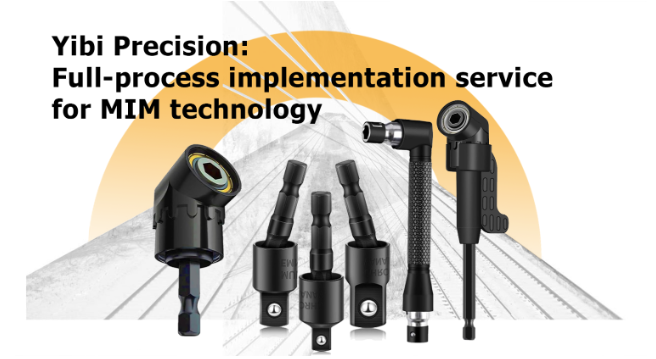
As a professional MIM contract manufacturing service provider, YibiPrecision delivers stable, scalable MIM solutions through a closed-loop”design-material-process-inspection” chain, precisely matching brushlesslithium-ion tool needs:
1. Design: DFM Customization
Yibi Precision provides customized DFM (Design for Manufacturing) servicesduring the design phase, avoiding production defects from the source: wallthickness difference strictly controlled within 0.5mm to preventdebinding/sintering deformation; scientific draft angle setting and internalstructure optimization to reduce closed inner cavities; split design orminimally invasive processing solutions for undercut requirements.
2. Material: Scenario-Specific Powder Selection
Powders are selected based on tool scenarios and performance needs: high-quality powder with high sphericity (20-45um) and uniform particle sizeensures feeding fluidity and molding stability; high-alloy powders for highhardness, stainless steel/titanium alloy for corrosion resistance; all powdersare free of lead, mercury, and other prohibited substances to ensurecompliance.
3. Process: Precise Control of Core Procedures
Key processes of debinding and sintering are strictly managed: gradientheating for debinding to prevent binder decomposition and cracking;customized sintering schemes (vacuum sintering for stainless steel,hydrogen-protected sintering for alloy steel); heat treatments such asquenching and tempering to enhance hardness and wear resistance.
4. Inspection: Full-Process Quality Control
A full-cycle inspection system is established: dimensional accuracy andappearance checks post-molding; density and hardness testing afterdebinding/sintering; dynamic balance and surface roughness inspectionsfor finished products. SPC (Statistical Process Control) is integratedthroughout to ensure consistency in million-unit-scale production.
IV. Industry Insight: MIM as a Core Competitiveness
As 2026’s brushless lithium-ion trends deepen, the process level of corecomponents has become a key driver of industry competition. Withcomprehensive advantages in complex structure forming, high-performanceadaptation, low-carbon compliance, and scalable cost reduction, MIM is nolonger an “optional process” but a “core enabler” for enterprises to breakthrough technical barriers and seize market opportunities.
For power tool manufacturers, early MIM adoption and integrating MIMprocess thinking into the design phase can effectively enhance productperformance, reduce production costs, and overcome compliance barriers.For precision manufacturing enterprises, focusing on MIM R&D for corecomponents of brushless lithium-ion tools and accurately matchingsegmented scenario needs will unlock broad market potential.
In the future, as MIM technology innovates (e.g., nano-powder MIM, low-temperature sintering), its application in core components of brushlesslithium-ion tools will expand further, driving the industry toward greaterefficiency, durability, and environmental friendliness.
If you are facing requirements such as precision, compliance, and massproduction cost reduction for core power tool components, welcome toconnect with Yibi Precision. We will provide you with end-to-endcustomized MIM services.