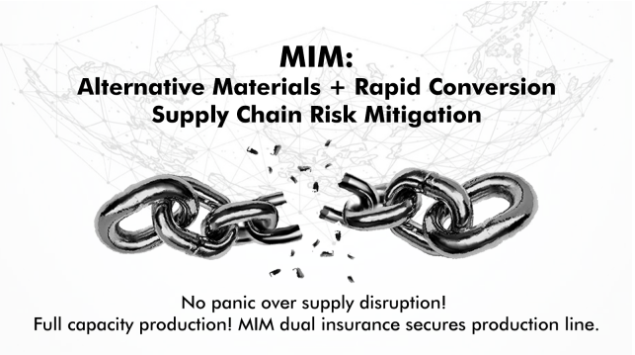
Amid escalating global supply chain volatility, volatile raw material prices,and overlapping geopolitical impacts, the tool industry is facingunprecedented supply shortage challenges – shortages of key materialssuch as tungsten, titanium, and rare earths, soaring logistics costs, andprolonged order delivery cycles. A shortage of a core part can halt an entireproduction line.
Traditional processing technologies struggle to respond to crises, whileMetal Injection Molding (MIM) technology, with its dual advantages of”flexible adaptation of alternative materials + rapid production switchingresponse,” is becoming a core barrier for enterprises to resist supply chainrisks.
I. The Supply Shortage Dilemma in the Tool Industry
The tool manufacturing industry is highly dependent on precision parts.From micro gears for mini household tools to special-shaped wrench headsfor industrial-grade tightening tools, the stable supply of core parts directlydetermines an enterprise’s survival and development. However, in thecurrent supply chain environment, supply shortage risks have evolved from”accidental events” to “regular challenges,” mainly concentrated in threescenarios:
- Raw material shortage: For example, sudden shortage of special materialssuch as certain stainless steel and titanium alloy due to production capacity,trade policies and other factors. Traditional CNC and forging processes haveextremely poor compatibility with material grades and specifications.Replacing materials requires re-conducting a large number of performancetests, which takes 2-4 weeks, directly leading to delayed order delivery.
- Upstream supplier breaches: Core part suppliers suspend production dueto equipment failures, financial problems and other emergencies. When toolenterprises temporarily switch suppliers, traditional processes have highproduction line adaptation costs and long cycles, making it difficult toquickly fill the gap.
- Emergency for customized orders: Cross-border e-commerce tool brandsand professional maintenance tool manufacturers often face small-batchcustomized orders. Traditional production lines have slow . . modelchangeover, and if the original part scheme cannot be implemented due tomaterial issues, there are almost no alternative solutions available.
Data shows that the global tool industry suffers an average annual capacityloss of 8%-12% due to part shortages, and a single medium-sized toolenterprise incurs annual losses exceeding 1 million RMB due to supplyshortages, including breach costs and customer churn.
II. MIM’s Dual Safety Net Mechanism
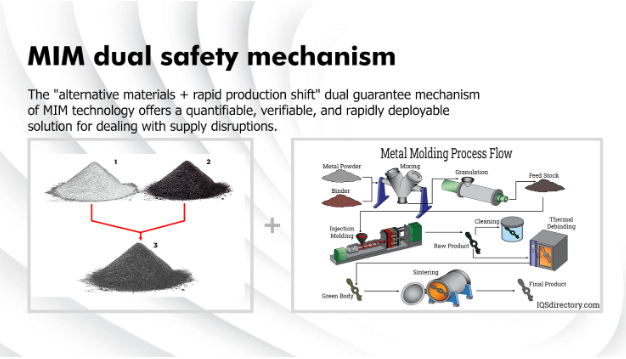
MIM technology uses metal powder as raw material to achieve near-netshaping through injection molding and sintering densification. Its processcharacteristics determine its inherent advantages in emergency supply chainscenarios.
The “alternative materials + rapid production switching” dual safety netmechanism essentially breaks the supply chain constraints of traditionalprocessing through process flexibility and production line standardization,providing tool enterprises with full-scenario emergency solutions.
First Safety Net: Flexible Adaptation of Alternative Materials
Traditional processing technologies rely on raw materials of specific formsand grades. For example, CNC processing relies on standard profiles, andforging relies on ingots of specific specifications. Once raw materials are inshort supply, enterprises are left with “no rice to cook.”
In contrast, the core of MIM technology lies in the shaping and sintering ofmetal powder, which has extremely strong material compatibility, enablingthree substitution capabilities: “same-performance substitution, low-costsubstitution, and non-standard adaptation.”
1. Same-performance substitution: For common materials used in tool partssuch as stainless steel, iron-based alloys, and copper-based alloys, MIM canquickly switch to same-performance powder raw materials. For example,when 304 stainless steel powder is out of stock, 316L stainless steel powdercan be directly used as a substitute. By adjusting parameters such assintering temperature and holding time, key indicators such as parthardness (HRC 45-55), wear resistance, and corrosion resistance can beconsistent with the original product, and the material utilization rateremains above 95%, far higher than the 70%-80% of traditional processing.
2. Low-cost substitution: On the premise of not affecting part performance,MIM can replace high-priced materials with low-cost ones throughoptimized powder ratio. For example, for copper-based alloy partscommonly used in the tool industry, if copper powder prices soar or are inshort supply, iron-based alloy powder combined with surface copperplating can be used to achieve equivalent performance substitution,reducing costs by 15%-20% while avoiding order stagnation.
3. Non-standard material adaptation: For the special material needs of high-end tools (such as aerospace maintenance tools and precision measuringtools), MIM can cooperate with material manufacturers to quickly developcustomized powders, completing prototyping and performance verificationof alternative materials within 72 hours, solving the pain point of traditionalprocesses being “unable to quickly adapt to non-standard materials.”
As a professional MIM service provider, Yibi Precision has established analternative material database covering more than 20 types of metalpowders, equipped with a professional material R&D team. Based on thepart performance requirements of tool enterprises, Yibi Precision can matchthe optimal alternative solution in the shortest time, realizing “noproduction shutdown due to material shortage.”
Second Safety Net: Rapid Production Switching Response
In supply shortage crises, “time is money” – the long model changeovercycle and high cost of traditional processing lines are the core reasons fororder breaches.
For example, switching from producing wrench parts to screwdriver bitsrequires CNC production lines to re-program, replace fixtures, and debugtools, which takes 2-3 days for the entire process, and even up to a week forcomplex parts. In contrast, MIM technology achieves a significant leap inproduction switching efficiency through “modular molds + standardizedprocesses
- Modular mold design: MIM molds adopt a “standardized frame +replaceable cavity parts” structure. For molds of different parts, only thecavity part needs to be replaced, without redesigning the entire set ofmolds.
- Full-process standardized control: From metal powder pretreatment,injection molding to degreasing, sintering, and post-processing, MIMtechnology can achieve full-process standardized operations, enablingproduction lines to quickly adapt to the production needs of different parts.
- Flexible capacity configuration: Multiple modular MIM production linescan be deployed to undertake multi-category, small-batch emergencyorders simultaneously, without worrying about production line conflicts,further enhancing production switching flexibility.
III. MIM Reconstructs the Supply Chain Ecosystem of the Tool Industry
It is worth noting that the value of MIM’s “alternative materials + rapidproduction switching” dual safety net lies not only in responding to supplyshortage crises but also in reconstructing the supply chain ecosystem of thetool industry:
Cost dimension: Alternative material solutions can help tool enterprisesreduce dependence on high-priced special materials, while rapid productionswitching reduces downtime losses, resulting in a 15%-30% reduction incomprehensive costs.
Efficiency dimension: Flexible capacity configuration can adapt to the toolindustry’s order trend of “small batches, multiple categories, andcustomization,” shortening the product launch cycle.
Compliance dimension: MIM technology has high material utilization rate(scrap rate <5%) and no chemical reagent pollution, complying with EU CE,US EPA and other environmental regulations, avoiding compliance fines.
IV. Conclusion: Building a Resilient Supply Chain with Tool Enterprises
Supply chain resilience has become a core element of competition in theinternational tool industry. MIM technology’s “alternative materials + rapidproduction switching” dual safety net mechanism provides overseascustomers with a quantifiable, verifiable, and rapidly deployable supplyshortage solution.
As a professional MIM service provider, Yibi Precision has passed ISO9001/14001 international certifications and has a complete supply chainsystem for European and American markets. We can provide you with:
Free evaluation of alternative material solutions
24-hour emergency sample delivery service
Bulk production guarantee in line with international standards
Exclusive account manager with full-process international follow-upservIces
Whether you are facing material shortages, supplier breaches, or need toquickly respond to small-batch customized orders, Yibi Precision can beyour “strategic partner,” helping you maintain a competitive advantageamid global supply chain volatility.