
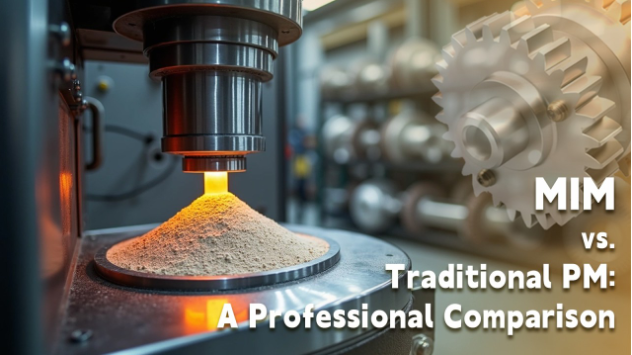
In the production type selection for precision structural components, MetalInjection Molding (MIM) and traditional Powder Metallurgy (PM) both fall under the powder metallurgy technology system, yet they cater to entirely different product requirements and cost structures.
1. Core Process Logic Differences
- Traditional Powder Metallurgy (PM)
The process involves compression molding of metal powders, followed by sintering and sizing to complete production.
It features mature technology and extremely low costs, making it more suitable for components with simple, symmetrical structures and thick walls.
-
Metal Injection Molding (MIM)
This technology integrates powder metallurgy and injection molding processes. It uses fine metal powders mixed with binders to produce feedstock, which is then formed through injection – debinding – sintering.
Its advantages include one-step molding of complex 3D structures, special-shaped parts, thin-walled parts and multi-feature integrated parts, significantly reducing secondary processing and assembly work.
2. Key Performance and Precision Comparison
- Density
PM:≈85%-90%
MIM: ≈95%-98%, with mechanical properties close to those of forgings
-
Dimensional Accuracy (as-sintered)
PM: Mainly +0.03~+0.2 mm
MIM: +0.05~+0.3 mm, up to +0.02~+0.05 mm with finish machining
-
Surface Roughness
MIM can stably achieve Ra 1.6-6.3 um, delivering superior appearance and texture.
-
Material Range
PM is primarily limited to iron-based and copper-based materials.
MIM enables mass production of difficult-to-machine materials such as stainless steel, titanium alloy and superalloy.
3. Cost and Mass Production Logic
-
Traditional PM
Suitable for both small and large components; it has an overwhelming costadvantage for simple parts and offers high cost performance in mass production.
-
MIM
Costs do not rise sharply with the increase in component complexity, and itcan integrate multiple parts into a single structure, reducing assembly costs.
4. Summary of Application Scenarios
-
Choose Traditional PM when:
The component has a simple structure, requires mass production for ultra-low cost, and has general performance requirements.
-
Choose MIM when:
The component features complex special shapes, high precision, high density, special material requirements, minimal or no secondary processing, and integrated design.
Yibi Precision . MIM OEM Capabilities
We specialize in the one-stop MIM manufacturing process:
Powder selection – Compounding Injection molding – Catalytic/thermaldebinding High-temperature sintering Post-processing (CNC machining, polishing, sandblasting, etc.)
We are stably capable of undertaking MIM mass production OEM projects in the following fields:
Automotive precision components, high-end tools, consumer electronics, medical accessories, etc.
If you are currently engaged in:
- R&D of complex metal structural components
- Process selection (PM / MIM / die casting / machining)
- Cost reduction for high-precision mass production of small parts
Feel free to contact us for discussion at any time. We can help you optimizeMIM process feasibility starting from the design stage.