
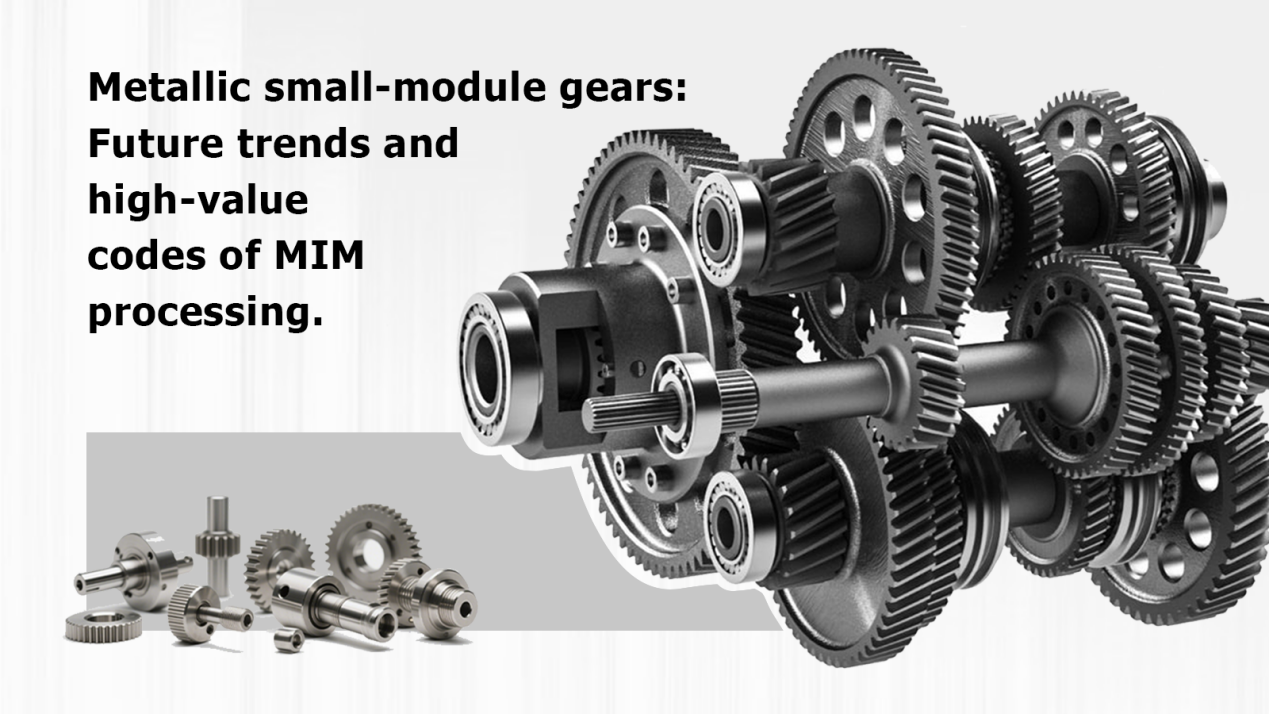
Amid the wave of high-end manufacturing evolving toward “miniaturization, high precision, and high reliability,” metal small-module gears—dubbed the “industrial micro-nerves”—have become the core support for precision transmission systems. By virtue of their deep compatibility with MIM (Metal Injection Molding) technology, they not only break through the performance limits of micro-transmission but also emerge as a key track for high-end manufacturing upgrades, becoming one of the core competitiveness for enterprises vying for a share in the global high-end supply chain.
- What Are Metal Small-Module Gears?
Metal small-module gears are defined as metal transmission components with a module (a core parameter of gear tooth profile, m=t/π where t is the circular pitch) ≤ 1mm. The industry’s focus on “ultra-small specifications” has pushed the standard to extremes—modules ranging from 0.06 to 0.1mm (tooth profiles as fine as human hair), diameters from 2 to 3mm (tooth thickness from tens to hundreds of microns), mainly covering the mainstream range of 0.6~5mm tooth outer diameter and 0.06~0.5mm module, precisely meeting the transmission needs of micro-equipment.
Their core characteristics fully align with the rigorous requirements of precision manufacturing:
- Extreme Environment Adaptability: Stable thermal expansion coefficient and near-zero water absorption rate. Within the temperature range of -40℃~120℃ (including high-low temperature cycles) and complex working conditions such as weak acid corrosion, hardness and mechanical strength remain stable without significant degradation.
- Efficient and Low-Consumption Transmission: Excellent tooth surface precision enables low-wear, low-energy operation. Smooth and noise-free meshing at high frequencies effectively avoids transmission failures such as metal adhesion and jamming.
- Material and Performance Flexibility: Compatible with various metal materials such as stainless steel and titanium alloy, supporting post-processing optimizations like hardening and coating. Hardness stably reaches HRC 30~40, with customizable performance for specific scenarios.
- Ultimate Space Adaptability: Achieves high-precision transmission in compact spaces (as small as a fingernail), providing sufficient structural flexibility for the miniaturization design of high-end manufacturing and breaking the space constraints on transmission performance.
- Why Are Metal Small-Module Gears Irreplaceable?
The irreplaceability of metal small-module gears stems from their critical support for the core demand of “high-precision transmission in micro-spaces.” Taking the lock and tool industry as an example, their comprehensive advantages have no substitutes among other transmission components:
- High-End Lock Scenarios: Smart lock fingerprint modules, bank vault locks, and other products require precise transmission in milliliter-scale cavities, withstanding complex environments while maintaining low wear and no debris. With a transmission accuracy of ±0.005mm and stable performance, metal small-module gears directly determine product reliability and have become a standard configuration for high-end locks.
- Precision Tool Scenarios: Micro electric tools and industrial testing tools operate at high frequencies and require wear-resistant, stable transmission components. Metal small-module gears retain precision even after long-term meshing, serving as the core support for their market application.
From locks and tools to various micro-precision equipment, the demand for “small space + high precision + strong stability” is increasingly universal—this is the core logic behind the irreplaceability of metal small-module gears.
III. MIM Technology: Solving the Manufacturing Dilemmas of Small-Module Gears
The manufacturing of metal small-module gears (especially ultra-small specifications with module <0.1mm and diameter <3mm) has long been constrained by technical bottlenecks. Balancing micron-level precision requirements, large-scale supply capacity, and cost control is hailed as a “world-class technical challenge.” Traditional processes struggle to meet these three core demands, while MIM technology provides a precise solution. The detailed comparison is as follows:
| Processing Method | Core Pain Points (for Small-Module Gears) | MIM Technology Solutions |
| Traditional Cutting Processes | High tool wear; difficulty in forming tooth profiles with module <0.3mm; prone to deformation and micron-level errors; material utilization rate of 30%~50% leading to high costs | Stable forming of gears with module as low as 0.05mm and precision of ±0.005mm (IT10-IT12 grade); material utilization rate over 95% and 40% cost reduction |
| Stamping/Precision Casting | Stamping cannot achieve complex structures; casting has low precision and many pores; extensive post-processing required with low efficiency | Integrated forming of helical gears, “gear + shaft” structures, etc.; single-cycle time of 10~20 seconds, mold life exceeding 1 million cycles, and yield rate over 95% |
| Mass Production | Yield rate below 85% and unstable large-scale supply | Stable yield rate over 95%, supporting seamless transition from small-batch trials to million-level mass production |
In addition, MIM technology is compatible with post-processing such as hardening, coating, and micro-shot peening surface strengthening (e.g., micro-shot peening can form residual compressive stress above -800MPa, extending gear life by 3x), further enhancing corrosion and wear resistance.
- MIM + Small-Module Gears: A High-Value Direction in Precision Manufacturing
The integration of MIM technology and metal small-module gears has become an industry core trend, driven by the “natural alignment between process characteristics and product rigid demands.” MIM’s core advantages precisely match the manufacturing essence of small-module gears, combined with market demand, forming an irreversible development direction:
- Extreme Specification: Modules are approaching below 0.05mm, and diameters are compressed to within 1mm. Leveraging MIM’s precision advantages, it adapts to cutting-edge tracks such as humanoid robots and micro-medical devices, seizing technological commanding heights.
- High-Value Application: Expanding from general civilian scenarios to high-value-added fields such as high-end smart locks, industrial testing tools, and minimally invasive medical devices. MIM’s high stability enables gears to adapt to harsher working conditions, bringing more stable demand and sufficient profit margins.
- Process Integration: MIM can realize integrated forming of multi-component structures such as “gear + shaft + bearing,” which not only reduces internal equipment space and improves transmission efficiency but also lowers overall costs by reducing processing steps. This helps customers enhance their core product competitiveness and better secure high-value orders.
For global precision manufacturing enterprises, the deep integration of MIM technology and metal small-module gears solves the core pain point of “miniaturization vs. high performance” and positions them as a core trend for enterprises to build high-end products. It not only provides stable and reliable precision transmission solutions for high-value products but also helps enterprises enter the global high-end supply chain with ultra-high-standard components, seizing irreversible growth opportunities. In the future, whether in mature fields or cutting-edge tracks, metal small-module gears manufactured via MIM will remain an indispensable core support for high-end products.
If you have needs for precision components (small-module gears / complex precision structural parts) such as precision improvement, complex structure forming, large-scale mass production, or cost optimization, welcome to message Yibi Precision. We will provide free process evaluation, sample prototyping, and customized MIM processing solutions to help you seize high-end market opportunities.