
The global competitiveness of high-end smart locks lies in the ±0.03mm gap of the lock cylinder — the critical threshold for the EU EN 1303 anti-drilling standard and the core requirement for North America’s ANSI/BHMA 1 million-cycle failure-free performance. Trapped in the dilemma of “high precision = high cost” and “large-scale production = low precision,” Metal Injection Molding (MIM) technology breaks through with cross-process innovation. Boasting stable mass production precision of ±0.03-0.05mm, it has become the key choice for global premium lock manufacturers to overcome growth bottlenecks.
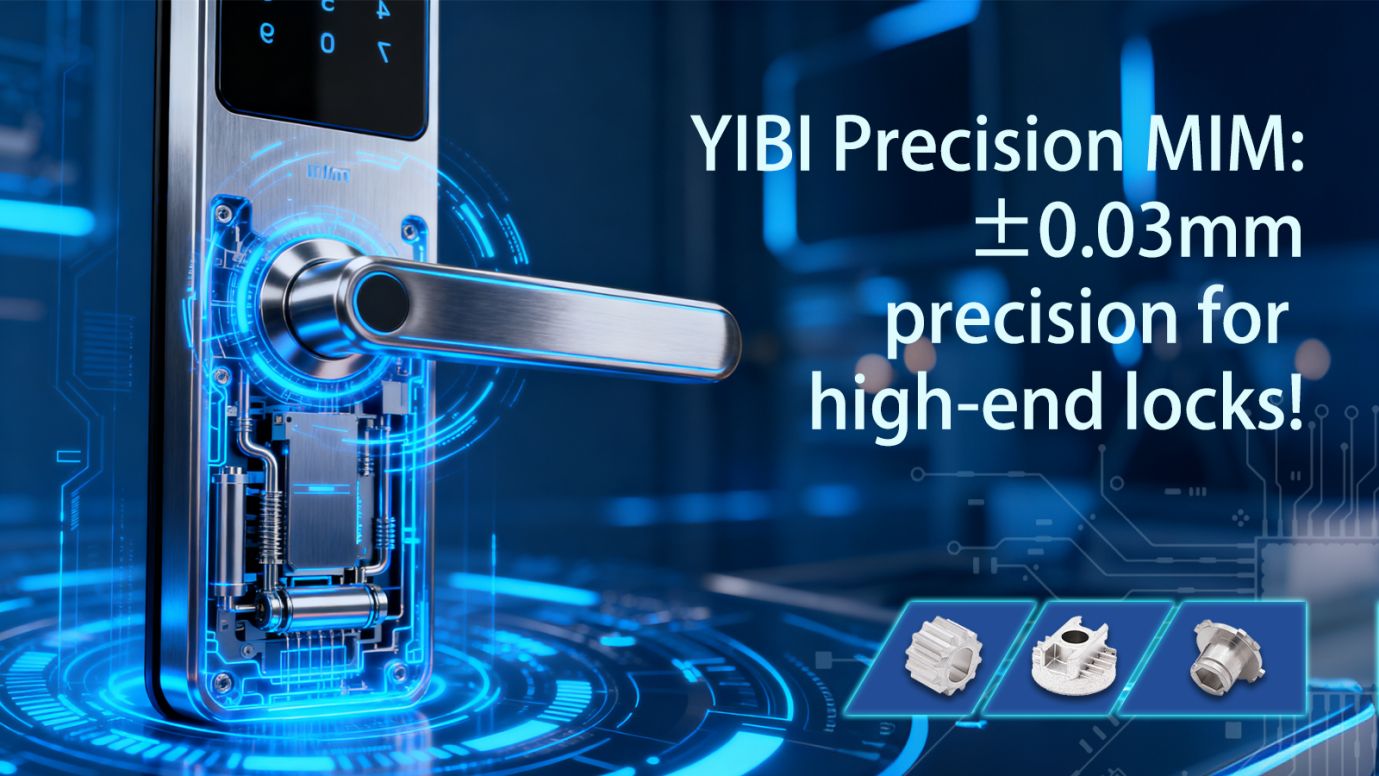
1. Why ±0.03mm Precision Is Non-Negotiable for Premium Lock Manufacturers?
For high-end lock brands, ±0.03mm is no “technical gimmick” but a core prerequisite for meeting market demands and realizing commercial value, driven by three fundamental logics:
• A Mandatory Threshold for Security Performance
The engagement precision of lock cylinder pins and blades directly determines anti-pry effectiveness. When dimensional error exceeds ±0.05mm, enlarged component gaps reduce forced entry difficulty by over 30%. With ±0.03mm precision (99% component fit), the anti-pry rating elevates from Grade C to Enhanced Grade C, easily complying with international anti-drilling standards such as EU EN 1303 and North America’s ANSI/BHMA, and clearing the path for entry into global high-end markets.
• A Core Guarantee for Long-Term Durability
Transmission gears and handle shafts of smart locks endure dozens of opening/closing cycles daily. Insufficient precision causes uneven stress and accelerated abnormal wear, reducing service life from 100,000 cycles to less than 30,000. The dimensional consistency of ±0.03mm cuts abnormal wear by 80%, doubling lock durability while significantly lowering after-sales maintenance costs and strengthening brand reputation.
• A Key Driver of Brand Premium
Precision deviations lead to jittery operation and difficult key insertion, directly undermining user experience. MIM’s tight component fit improves operational smoothness by approximately 50%, becoming a core selling point. More importantly, products achieving ±0.03mm precision command a 30%-80% price premium over standard models and gain easier access to high-end European and North American sales channels, substantially expanding profit margins.
2. Why Traditional Processes Struggle to Break Through Precision Bottlenecks?
Core lock components (cylinders, pins, transmission gears) range from 3-20mm in size, requiring fitting gaps ≤0.05mm. However, traditional processes fail to balance “precision, efficiency, and cost” in mass production, with prominent pain points:
| Process Type | Precision Limitation | Efficiency/Cost Pain Points | Performance Shortcomings |
| Forging/Investment Casting | ±0.1-0.3mm | 3+ post-processing steps; only 85% batch qualification rate | Key jitter complaint rate exceeds 10% |
| Conventional CNC Machining | ±0.05-0.08mm (mass production) | Over 45 minutes per unit; 3-5x higher cost than MIM | Key interchange rate rises from 1/1000 to 1/200 |
| Traditional Powder Metallurgy | ±0.15mm | Density <80%; only 200-hour salt spray test compliance | Service life is only 30-40% of MIM components |
Core Issue: Traditional processes cannot simultaneously achieve “stable high precision, mass production efficiency, and cost control” — exactly MIM’s core advantage.
3. How Does MIM Deliver Stable ±0.03mm Mass Production Precision?
MIM’s breakthrough lies in end-to-end refined control across “Powder & Feedstock → Mold Design → Sintering → Inspection,” forming a stable and efficient mass production system — the core logic behind Yibi Precision’s reliable OEM services for lock manufacturers:
Powder & Feedstock: Control Deviation at the Source
- High-Grade Ultra-Fine Metal Powder: Adopts 2-15μm powder (industry premium standard) with ≥95% sphericity and uniform particle size distribution, ensuring consistent particle shrinkage during sintering. Tailors powder formulations to lock component material requirements (stainless steel, titanium alloy, etc.), controlling material shrinkage fluctuation within ±1%.
- Uniformly Mixed Feedstock: Achieves over 99% uniform blending of metal powder and binder via twin-screw mixing equipment. Real-time monitoring of feedstock flow stability keeps green part dimensional error within ±0.02mm, laying the foundation for final precision.
Mold Design: Precision Compensation to Offset Sintering Deformation
- Data-Driven Shrinkage Compensation: Based on extensive production data, establishes shrinkage rate ranges (15-20%) for different materials and structures. Precision scaling of mold cavities offsets natural sintering shrinkage, ensuring finished product dimensional accuracy.
- Targeted Structural Optimization: Uses simulation tools to predict deformation-prone areas. Local cavity thickening and fillet optimization control deformation within ±0.01mm, guaranteeing consistent precision in mass production.
Sintering Process: Stable Control for Dimensional Uniformity
- Precision Temperature Control: Employs graphite hot-zone sintering furnaces with ±1℃ temperature uniformity in the effective zone. Gentle heating curves prevent warpage caused by thermal stress, tailored to the thin-wall characteristics of lock components.
- Vacuum & Debinding Control: Maintains high vacuum with inert gas protection, controlling part oxygen content below 300ppm to ensure material strength and avoid oxidation-induced dimensional deviations. Adopts “stepwise debinding + gradient sintering” with a debinding rate ≤5%/h to prevent part cracking from rapid binder volatilization.
End-to-End Inspection: Closed-Loop Control to Eliminate Defective Parts
- Dual Inspection System: 100% contour inspection of green parts via blue light scanners; 100% sampling inspection of critical dimensions for finished parts using coordinate measuring machines (CMM, precision ±1μm).
- Data-Driven Closed-Loop Optimization: ISO9001-certified full traceability of inspection data for each batch. Real-time adjustment of process parameters (sintering temperature, injection pressure, etc.) upon detecting precision deviation trends, ensuring stable mass production precision within ±0.03mm.
4. Yibi Precision: MIM Precision Expert, Trusted by Premium Lock Manufacturers
With 16 years of dedicated MIM technology implementation, we focus on “stable precision, reliable delivery, and cost optimization,” providing end-to-end customized solutions from feedstock R&D and process optimization to mass production delivery.
No additional investment is required. Whether meeting the ±0.03-0.05mm precision requirements for precision lock components or custom needs for various high-end precision parts, we deliver full-cycle support with mature technology and extensive experience.
📩 Connect with Yibi Precision Today
Unlock the competitive advantages of ±0.03mm mass production precision and seize opportunities in the global high-end lock market!