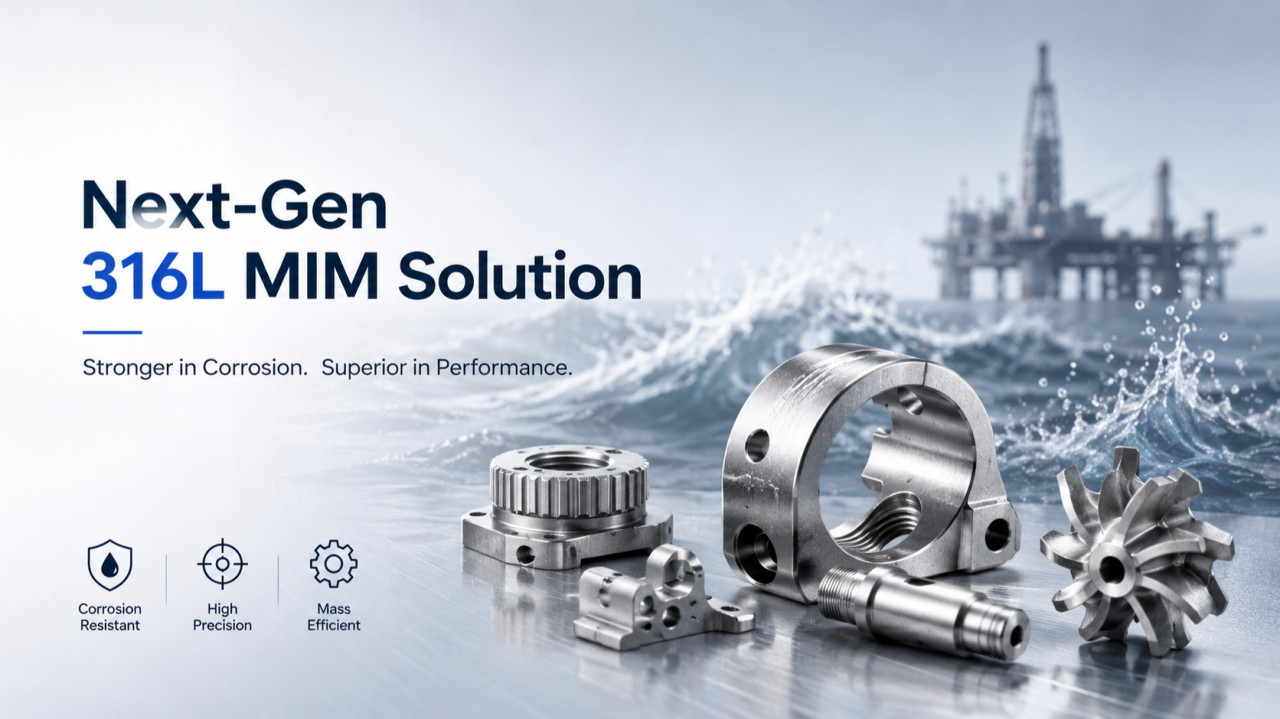
316L stainless steel combined with Metal Injection Molding (MIM) process has become the “gold standard” for precision parts in general applications. It has been widely adopted in consumer electronics, home hardware, and general machinery, fully meeting the requirements of indoor and freshwater environments.
However, as the reliability requirements of high-end manufacturing continue to rise, the inherent porosity of powder metallurgy processes limits its long-term service capability in harsh environments such as high-salt spray and acidic conditions. This is a common technical challenge restricting its further penetration into high-end sectors including marine engineering, medical devices, and new energy.
Through independently developed composition optimization and proprietary special sintering technologies, Yibi Precision has launched a new generation of modified 316L material. This material fully retains the core advantages of the original process and material, while significantly breaking through performance boundaries. It provides global customers with a full-gradient material solution covering “general scenarios – high-end harsh scenarios”, achieving the optimal balance of high performance, low cost, and high manufacturability.
1. Industry Challenge: The Performance Ceiling of Standard MIM 316L
Standard 316L is the most widely used material in MIM applications. However, limited by sintering characteristics, as-sintered parts inevitably have micro-pores. These pores act as penetration channels for corrosive media, resulting in significantly lower actual corrosion resistance compared to wrought materials of the same grade—this effect is particularly pronounced in chloride-containing acidic and marine environments.
It should be emphasized that residual porosity is an inherent characteristic of powder metallurgy processes, not unique to MIM nor a product quality issue. However, the fine, uniformly interconnected pores formed by MIM ultra-fine powders have the most significant impact on the corrosion resistance of stainless steels.
Industry-recognized as-sintered performance benchmarks:
- Hardness: 120-150HV, with limited wear resistance and deformation resistance
- Pitting Resistance Equivalent Number (PREN): ≈24, comparable to wrought 316L, but actual corrosion resistance is greatly reduced due to porosity
- Unpassivated neutral salt spray: rusting begins at 48-120 hours
- Standard passivated neutral salt spray: red rust appears at 200-500 hours
- CASS acidic salt spray: significant corrosion occurs at 24-72 hours
This performance ceiling limits standard MIM 316L to mild indoor and freshwater environments, failing to meet the long-term reliability requirements of high-end manufacturing.
2. Inherent Limitations of Existing Alternative Solutions
The industry commonly uses 17-4PH, 2205 duplex steel, and titanium alloys as alternatives. However, all have significant drawbacks when evaluated in terms of mass production, cost, and supply chain:
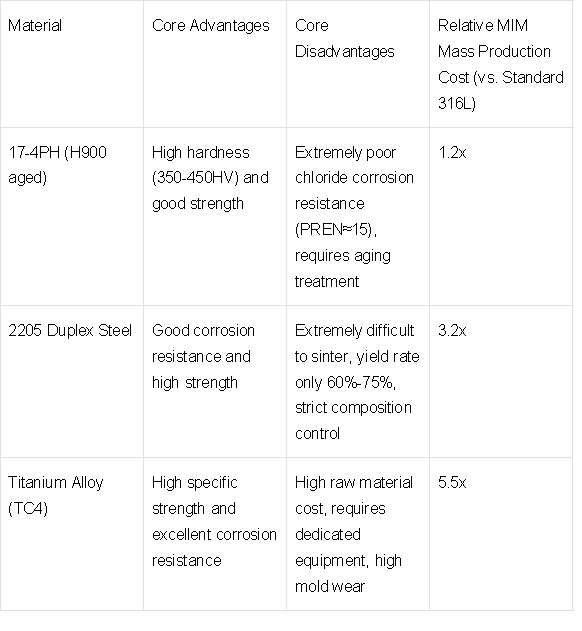
All these solutions force customers to compromise between performance, cost, and delivery, failing to achieve optimal comprehensive benefits.
3. Modified 316L: Breaking the “Performance-Cost-Manufacturability” Impossible Trinity
Unlike industry-standard solutions, Yibi Precision achieves a leap in performance while retaining all MIM advantages through precise control of key alloy ratios (chromium, molybdenum, nitrogen) and proprietary optimized vacuum high-pressure sintering processes.
Core Performance Comparison (Measured by Yibi Precision’s Mass Production Process; Full Original Reports Available)

Three Core Differentiated Advantages
- Comprehensive Performance Upgrade, Expanded Application Boundaries Doubled hardness with significantly enhanced wear resistance and dimensional stability, suitable for load-bearing and moving parts. 4-12x improved corrosion resistance, with a PREN index approaching that of super duplex steel 2507, enabling long-term stable application in coastal, outdoor, and mild industrial corrosive environments.
- Seamless Compatibility with Existing Processes, Minimal Switching Risk This is the core advantage over other alternative materials. Powder flowability and sintering shrinkage are highly consistent with standard 316L. In most cases, no redesign or retooling is required, and no major adjustments to production line parameters are needed. Existing customers can upgrade simply by changing raw materials, reducing the certification cycle from 6-12 months to 1-2 months.
- Significantly Lower Total Cost of Ownership (TCO) Unit purchase cost is approximately 60% higher than standard 316L. However, by eliminating passivation processes, reducing maintenance, minimizing downtime, and lowering warranty expenses, the 5-year TCO is 58% lower than standard 316L and 43% lower than 2205 duplex steel in typical marine engineering scenarios.
4. Cross-Industry Applications: One Solution, Three Core Problem Categories
Corrosion failure of standard MIM 316L is a common bottleneck in marine engineering, medical devices, new energy, and other sectors. Yibi Precision’s modified 316L, with its “performance leap + seamless switching” advantages, has become the industry’s optimal comprehensive solution. It creates unique commercial value for different industries through material upgrade alone.
4.1 Marine Engineering: From “Annual Replacement” to “5-Year Warranty”, Reshaping Industry Standards
- Marine hinges, fasteners, and deck fittings are long exposed to high-salt spray environments. Standard 316L corrodes on average after 12 months, leading to annual warranty claim rates exceeding 8% and damaging brand reputation.
- The rust-free service life is increased from 1 year to over 5 years, reducing warranty costs by 90%. Enabled a leading European marine hardware manufacturer to upgrade from the industry-standard 1-year warranty to an exclusive 5-year warranty, establishing a market barrier.
4.2 Medical Devices: Overcoming Sterilization Corrosion Challenges, Accelerating Global Regulatory Compliance
- Surgical instruments and dental accessories are prone to pitting after repeated 134°C autoclave sterilization, posing a cross-infection risk. FDA/CE certification cycles for new materials can take 8-12 months, delaying product launches.
- Passed 500+ autoclave cycles without corrosion, with biocompatibility compliant with ISO 10993 standards. Material validation cycle reduced by 75%, helping customers quickly enter high-end European and American markets.
4.3 New Energy: Meeting Long-Life Requirements, Ensuring Long-Term Equipment Reliability
- Electric vehicle charging connectors, industrial valve spools, and photovoltaic bracket accessories require 10+ years of service in complex outdoor environments. Corrosion of standard 316L can lead to poor contact and seal leakage, resulting in high maintenance costs.
- Core component service life extended by 3-5 times, on-site maintenance costs reduced by 80%, fully meeting the long-term reliability and safety requirements of the new energy industry.
Conclusion
The launch of Yibi Precision’s modified 316L MIM material is not only a material performance upgrade but also a major breakthrough in MIM application fields. It provides global customers with an unprecedented balance: high performance comparable to special alloys without sacrificing cost, delivery cycle, or design freedom.
As a professional contract manufacturer with over 10 years of deep expertise in MIM, Yibi Precision not only has mature mass production processes and a stable supply chain for modified 316L but also offers comprehensive MIM customization services for stainless steels, iron-based alloys, titanium alloys, cemented carbides, and other materials. We provide one-stop solutions from design optimization and mold development to process validation and mass production, empowering global customers to boost their product competitiveness.