
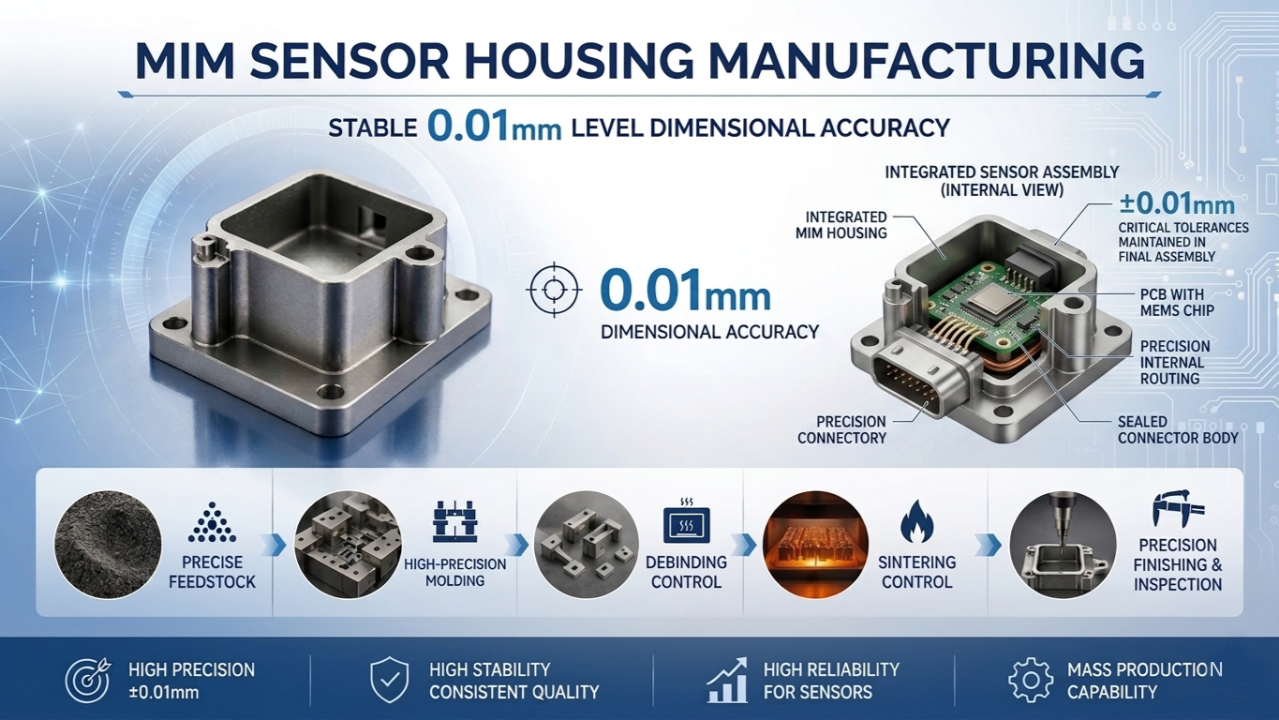
Against the backdrop of ongoing miniaturization in automotive electronics, industrial sensing, and consumer electronics, the performance bar for sensors continues to rise. Dimensional accuracy, the cornerstone of sensor reliability, remains a top industry priority: a mere 0.01mm dimensional deviation can cause seal failure and poor assembly, directly compromising sensor reliability and mass production yield.
To meet IP67/IP68 sealing requirements and ensure precise assembly of internal MEMS sensing elements, critical dimensional tolerances for sensor housings typically need to be controlled within ±0.01mm. For traditional CNC machining, this precision requirement translates to prohibitive manufacturing costs and stringent control challenges, while complex internal cavities and thin-walled structures further raise the processing threshold.
Yibi Precision, a dedicated MIM contract manufacturer, has provided reliable manufacturing solutions to over 200 overseas customers across Europe, North America, and other regions. Through meticulous end-to-end process control, we consistently achieve 0.01mm dimensional accuracy for micro-precision components such as sensor housings, while helping customers optimize mass production costs—delivering cost reductions of over 50% compared to traditional CNC solutions.
Core of Precision Control: Systematic Optimization Across 5 Key Stages
The standard mass production accuracy of MIM processes in the industry is ±0.3% to ±0.5%. Achieving absolute 0.01mm precision requires coordinated control across the entire workflow, from material selection to final delivery:
1. Material Stage: Customized Ultra-Fine Feedstock
Material consistency is the foundation of precision. We have developed proprietary feedstock formulations specifically for sensor components:
- Utilizing ultra-fine spherical metal powders with particle size ≤5μm to ensure powder flowability and uniform sintering shrinkage;
- Employing twin-screw compounding to control the mixing deviation between binder and powder within 0.1%, minimizing dimensional fluctuations caused by uneven local shrinkage at the source.
2. Tooling Stage: Precise Pre-Shrinkage Compensation
The MIM process undergoes 15% to 20% linear dimensional shrinkage during the debinding and sintering stages, which is the core of precision control.
Leveraging our years of accumulated process databases and CAE simulation, we apply precise shrinkage compensation to tooling dimensions in advance:
- Tooling is manufactured using high-precision mirror electrical discharge machining (EDM), with inherent machining accuracy controlled within ±0.005mm;
- Developing proprietary shrinkage compensation models for components of different materials and structures to offset dimensional changes during sintering. We implement differentiated local compensation for thin-walled, thick-walled, and heterogeneous structures, rather than simple overall linear scaling.
3. Molding & Debinding: Smooth Transition to Eliminate Invisible Deformation
Debinding is the transition stage in MIM where deformation is most likely to occur, and the uniformity of green parts directly determines the stability of subsequent debinding and sintering. We have implemented dual closed-loop control for this stage:
- Full closed-loop parameter control during the injection molding stage, with fluctuations in injection pressure and holding time limited to within 0.5%, ensuring consistent density of every green part and preventing subsequent shrinkage deviations caused by uneven green parts at the source;
- Adopting a “stepwise catalytic debinding process”: first removing 70% of the base binder via solvent debinding, then smoothly removing the remaining polymer components through catalytic debinding, controlling residual binder content after debinding within 0.5%. Combined with vacuum debinding atmosphere control to prevent green part oxidation, we effectively eliminate blistering and deformation risks during debinding, producing uniformly porous brown parts for subsequent sintering.
4. Sintering Stage: Ultimate Temperature Field and Atmosphere Control
Even minor fluctuations in sintering temperature directly affect component shrinkage rates. We have implemented comprehensive optimizations for this:
- Sintering furnaces adopt zone temperature control technology, with furnace temperature field uniformity controlled within ±2℃, effectively reducing dimensional deviations caused by over-sintering or under-sintering;
- Utilizing inert gas-protected vacuum sintering to control furnace oxygen content within 300ppm, preventing dimensional deviations caused by component oxidation. We also optimize the gradual heating curve to eliminate thermal stress warping risks for thin-walled components.
5. Post-Processing & 100% Inspection Control
For critical dimensions of sensor housings, we provide micro-precision sizing processes to further tighten tolerances to ±0.01mm on the basis of near-net-shape forming.
We have also introduced 3D vision measuring instruments and automated in-line inspection systems to perform 100% inspection of critical dimensions for every component. This ensures stable batch yields of over 99%, a Process Capability Index (CPK) of ≥1.33 for mass production critical dimensions, and consistent dimensional accuracy for million-unit supply volumes.
Most manufacturers in the industry only achieve the standard accuracy of ±0.3% to ±0.5%. The core bottleneck lies in their neglect of deformation control during the debinding stage and reliance on empirical overall shrinkage compensation, which fails to address the local shrinkage differences of heterogeneous structures in sensor housings. Through meticulous end-to-end closed-loop control, we have completely broken through this precision bottleneck.
Case Study: Mass Production Support for a European MEMS Sensor Customer
We previously collaborated with a European MEMS pressure sensor customer who faced significant challenges: their micro pressure sensor housing required critical dimensional tolerances of ±0.01mm, but their previous manufacturing solution encountered bottlenecks in precision stability and mass production yield. Additionally, CNC machining could not meet their cost and lead time requirements for production ramp-up.
By implementing our high-precision MIM solution, we completed process validation within 2 weeks and achieved the following results in mass production:
- Critical dimensional tolerances stably controlled within ±0.008mm, fully meeting the customer’s precision requirements;
- Batch yield increased to 99.2%, with an industry-leading low defect rate;
- Production cost reduced by 52% compared to the original CNC solution, and lead time shortened to 12 days.
To date, we have stably supplied over 1 million units for this project, with critical dimensional fluctuations consistently within the standard range and no batch defects. This has enabled the customer to successfully complete the production ramp-up of their new product.
Yibi Precision’s MIM Contract Manufacturing Advantages
As a leading MIM contract manufacturer in China, we provide overseas customers with manufacturing solutions that combine technical expertise and supply chain advantages:
- High-precision control capability: Consistently achieving ±0.01mm critical dimensional tolerances for micro-precision components, meeting the stringent requirements of high-end sensors;
- Unmatched cost optimization: Leveraging China’s mature MIM industrial chain, our pricing is over 30% lower than that of local European and American suppliers. Additionally, the MIM process achieves a material utilization rate of over 99%, far exceeding traditional CNC machining, enabling cost reduction from the raw material stage;
- Fast delivery capability: From sample development to mass production delivery, we can deliver projects in as little as 2 weeks, cutting lead times by 50% compared to European and American suppliers and helping customers accelerate their time-to-market;
- End-to-end technical support: Our team of professional engineers provides full-cycle support from design optimization and process validation to mass production delivery, promptly addressing customers’ development and production needs.
If your sensor products are facing precision bottlenecks in housing manufacturing, or if you are struggling with the high costs and long lead times of local European and American suppliers, please feel free to connect and message us directly. We offer free DFM (Design for Manufacturability) analysis, precision feasibility assessment, and customized solution design to help you bring your products to market quickly.